
Lushhome :: Online news and information on Singapore property market

Archive for the 'Conservation' Category


Wanted: New ‘director’ for Capitol Theatre

Posted by lushhomeonline on April 27, 2008

It is up for tender again, as part of a cluster with three other buildings

An announcement earlier this month may not have been the first time the authorities have declared plans for the historic Capitol Theatre, but it was still music to the ears of those who love the grand old dame.

Something was different this time around: The 79-year-old neoclassical theatre, which has been boarded up and abandoned for the past decade, will be put up for tender with three neighbouring buildings as one site next year.

Unlike a false start in 2000 when the Government proclaimed that the theatre would be converted into a performing arts centre, then later said it could not find investors who would bite, a new lease of life for the iconic building looks like it could finally become a reality.

‘With a larger site, you can do more. You also need a certain clustering. There’s lots of potential there,’ said Mrs Ong Choon Fah, executive director of research and consultancy at property firm DTZ Debenham Tie Leung.

It is an assessment shared by other property pundits.

Colliers International executive director of investment sales Ho Eng Joo said: ‘It’s easier to coordinate usage and shops. If you develop them individually, you may lose the theme and mix.’


The other three buildings offered in this 1.45ha four-in-one deal are Capitol Building, Stamford House and Capitol Centre.

The Urban Redevelopment Authority has no other details about the tender and would say only that it is studying the timing and details of the development.

But this critical mass, combined with a choice location - in the heart of the civic district and across from Raffles City MRT station - spells promising possibilities.

But there is a catch: Three of the four buildings have been gazetted for conservation.

Stamford House was restored to the tune of $13 million in 1994, Capitol Building and the theatre were given an $11 million facelift two years before that, although Capitol Theatre was to shut its doors for good in 1998.

That means any developer who successfully bids for the Capitol cluster will not only have to restore the theatre to its former glory, but also try to integrate the buildings while sticking to official conservation rules.

‘The history and architecture should be properly dealt with by the developer, regulator and designer to ensure these are not overshadowed,’ said Mr Dinesh Naidu, a member of Singapore Heritage Society. He is now writing a book on Singapore’s modern architecture from the 1920s to the 1970s - including Capitol Theatre - commissioned by the society.

The Capitol cluster also belongs to a much larger heritage area stretching to Armenian Street, Bras Basah Road and City Hall.

And as the buildings are roughly of the same scale and boast wide pavements and an unexploited alleyway, they could contribute much to street life in the hands of a capable and creative developer, said architectural experts.

The biggest question, perhaps, is what to do with Capitol Theatre. Or rather, what not to do to it.

All those interviewed by The Sunday Times expressed the hope that it could be retained as a cinema or performing arts venue, given its high ceiling, cavernous space and stunningly intricate interior motifs like the 12 signs of the zodiac on the dome.

Singapore Repertory Theatre’s artistic director, Mr Gaurav Kripalani, remembered talking to the Singapore Tourism Board - which was given guardianship of Capitol Theatre - about possibly using it as the theatre company’s home about seven years ago.

But the cost of turning it into a performance space was ‘too prohibitive’, he said.

Naturally, he would like to see Capitol Theatre become a performing arts centre with a capacity of 1,000, which would plug a gap in mid-size performance spaces in Singapore.


‘One can only hope there’s an altruistic developer out there.’

Sure enough, finding an appropriate use for the theatre is something that worries heritage buffs.

‘To partition it into multi-levels is destroying the value of the building. It’s not just about the facade. The interior is more magnificent than the exterior,’ said Mr Naidu.

Among other items on the wish list for the theatre are a cinema showcasing the best of the region’s past and present films, a home for arts groups and even an art gallery - something that will bolster the cultural and educational buzz of the area which already has schools, museums and heritage buildings.

Of course, none of these even sounds remotely like money-churning projects.

‘Theatres don’t usually make it on their own economically unless they become a loss leader as part of a whole development,’ reasoned Mrs Ong.

‘If the theatre becomes part of a much larger development, it can be a draw for people to come in and it will stand a better chance.’

Another option is for Singapore’s arts or tourism agency to lease the space from its private developer to encourage artistic pursuits.

The likely scenario for the cluster, however, could well be a mixed development comprising a boutique hotel, shops and F&B outlets - possibly even an office block in place of the current Capitol Centre, which faces no preservation restrictions.

Mr Colin Tan, head of research and consultancy at Chesterton International, thinks retail may be the answer given the expected increase in the number of visitors once the integrated resorts are up.

And with the ongoing room crunch showing no signs of easing, accommodation is another viable option.

‘If you ask me now, offices are probably heading for an oversupply,’ he said.

The area - at 1.45ha - is considerably large, said property analysts, although given the conservation restriction, developers will not have the option of building up.

Mr Naidu believes the Capitol cluster can offer Singaporeans an alternative to a ‘big box air-conditioned mall’, even if it is shopping they are after.

Fill it with High Street-type shops and transform the unused back alley into a lively alfresco dining stretch, he suggested.

Architect Tan Kay Ngee, who was part of the design team for the neighbouring Singapore Management University, says clever designing will have to come into play to link the buildings, the old with the new.

One possibility is to build a half cover or semi-open courtyard along the alleyway, which Bugis Junction has done quite successfully, he said.

‘If it is a big shopping mall the developer wants, he will have to think about huge carparks. So it needs to be something more elegant, petite and exquisite,’ he said.

Mr Tan has another suggestion: Turn the current Capitol Centre into a city check-in for airlines to avoid the rush at the airport terminals.

Given its location - near City Hall MRT station - and its close proximity to the business district as well as tourist enclaves - it makes sense.

But not everyone has greeted the redevelopment news with excitement.

For existing tenants of these buildings, it means finding a new home elsewhere, and at inflated rents.

Ms Joy Loh, 34, owner of Eagle’s Eye Art Gallery in Stamford House, is sad to be moving out of the heritage building she loves next April, after 14 years.

But she hopes to see the area become an arts hub.

‘Every area should have a niche. With so many museums close by, this place should be for the arts,’ she said.


Source : Sunday Times - 27 Apr 2008

Posted in Conservation, General | No Comments »

Restoring old glory

Posted by lushhomeonline on April 21, 2008

Amber Road will enjoy a clubhouse that has been restored to its historic grandeur.

Developer Wheelock Properties said it spent $1.3 million to conserve, retrofit and furnish the double-storey building.

The stately bungalow was built in the 1900s, along what was then the seaside at Katong. Then known as The Pavilion, it was owned by the Elias family.

Some of its most striking features include panoramic stained-glass panels above the grand entrance, the extensive timber works and the cast-iron railing on the verandahs.

‘This grand clubhouse is like a precious gem,’ said Wheelock director Tan Bee Kim. ‘Home owners of The Sea View are inheriting a small part of Singapore’s historical legacy.’

<em>Source : Straits Times - 21 Apr 2008</em>

Posted in Conservation, General, Luxury Property | No Comments »

Sea View condo comes with a piece of local history

Posted by lushhomeonline on April 21, 2008

RESIDENTS of Wheelock Properties’ new The Sea View condominium will be able to take pride in the fact that they have a classic piece of Singapore’s history in their estate.

Conservation work on the stately Neo-classical style bungalow off Amber Road formerly known as Pavilion has been completed, Wheelock said in a press release yesterday. Pavilion was built in the early 1900s and was owned by the Elias family, an established Jewish family at the time. The bungalow was gazetted for conservation in 2004.

The developer spent $1.3 million on conservation, retrofitting and furnishing the 5,000 sq ft double-storey clubhouse which will house two games rooms, a multi-purpose room with a pantry and a function room.

The extensive work done includes both the external and internal structure. Some key features include a panoramic 12-panel stained glass above the grand entrance and cast iron railing on the verandahs of both floors.

‘We volunteered to conserve the house as we felt that it was worth preserving a piece of history. The architecture of the house is seen as key to the charming character of the Amber Road/Katong area,’ explained Wheelock Properties (Singapore) director Tan Bee Khim.

Wheelock has also invested almost $500,000 on two art installations at the clubhouse. Both works by renowned local artist Kumari Nahappan spell life and energy for the space and provide visual focal points and vibrant colour contrast to the seamless landscape of water and greenery.

Source : Business Times - 21 Apr 2008

Posted in Conservation, General, Luxury Property | No Comments »

Unwanted child of S’pore conservation?

Posted by lushhomeonline on April 20, 2008

For too long, the once-lovely Capitol Theatre has stood forlorn and forgotten, the unwanted child of Singapore conservation.

Newspaper reports once held out hope of it being transformed into a performing arts centre for musicals, plays and ballets.

That, alas, was in January 1996.

Even then, the report quoted government officials as saying that the plans were ’still being studied’.

Never mind that the site had been earmarked for development in 1984, and acquired by the state in 1987, nearly a decade earlier.

More delays followed. In 1998, Capitol screened its last movie and the cinema was shut down amid much sadness and hopeful talk of plans to put it to better use.

The project was handed over to the Singapore Tourism Board to pursue in 2000. But in 2006, it decided not to proceed and handed it back to the Singapore Land Authority. Last year, it was finally declared a conservation area.

Sadly, over the years, nobody seemed either to own the project or to care all that much about it.

So, pardon me, but I could not help being more than a little sceptical when I read a report earlier this month which talked of fresh plans for the Capitol Theatre and the structures around it - Capitol Building, Capitol Centre and Stamford House.

The report raised as many questions as it answered: Just what do the authorities now envisage for the site, which they say will be sold as an ‘integrated one’ next year? So far, officials have said only that the area has not been ‘fully maximised to its development potential’ - indeed! - and the ‘timing and details’ of their plans ‘are being finalised’.

Why has it taken decades for any progress to be made on conserving this area? What is the cost of leaving Capitol idle all these years, allowing it to crumble away to a dusty death? And just who will ensure that the plans are realised this time?

These are legitimate questions, not least since the buildings concerned are very much part of Singapore’s architectural heritage.

Capitol Theatre turns 80 next year. The neo-classical style building was built in 1929 by M.A. Namazie, an early Singapore pioneer of Persian origin. The accompanying four-storey building, where the popular Magnolia Snack Bar once stood, was completed in 1933 and called the Namazie Mansions back then.

The cinema was Singapore’s very first, where the likes of Charlie Chaplin and Douglas Fairbanks performed to promote their silent movies. In the 1960s, the Capitol hosted variety shows featuring performers like Sakura Teng and Rita Chao.

The adjacent Stamford House has an even longer history. It was designed for commercial use in 1904 by R.A.J. Bidwell, the man behind other outstanding buildings such as the Raffles Hotel and Goodwood Park Hotel.

Few seem to recall the furious debate that broke out in 1991 over whether Stamford House should be saved instead of Eu Court, built in the 1930s, across the street.

Then National Development minister S. Dhanabalan declared that Stamford House would be preserved as it had a ‘more outstanding architectural style’.

I was prepared then to give the minister the benefit of the doubt, and wait to see if the ramshackle Stamford House of those days would indeed be transformed into the conservation gem he envisioned.

So, when the Victorian facade of the building was unveiled three years and $13 million later, I had to concede that it did look splendid, as the minister had said.

But sadly, it never quite lived up to his promise of becoming ‘an active and successful commercial centre’, given its motley collection of furniture shops, galleries and eateries, several of which came and went.

The wider issue here is this:
Just how does Singapore go about conserving its architectural heritage, saving grand old buildings and giving new life to them?

Of course, given the space constraints on this tiny island, I have never believed in keeping buildings as museum pieces, or standing in the way of development.

But, in these days of globalisation and rapid change, a sense of place and continuity is needed if Singaporeans are to remain rooted to this country.

Indeed, at the moment, Singapore is undergoing another spurt of redevelopment. Just as in the 1980s and 1990s, when familiar sites like the modest C.K. Tang store or the huge open field where Ngee Ann City now stands gave way to skyscrapers, the Ion Orchard and Orchard Central are rising rapidly from the ground in Orchard Road. These, and the redevelopment of the Asia Hotel site in Scotts Road, as well as the new St Regis Hotel in Tanglin Road are transforming the face of the downtown area as we know it. 

So how to ensure continuity in the face of such change?

Well, to be fair, there have been quite a few success stories in conservation over the years, such as the Fullerton Hotel, Raffles Hotel, the National Museum, the old Parliament House, and the old St Joseph’s Institution building.

In these cases, the buildings’ structures were painstakingly conserved, even as their interiors were retrofitted to allow for new uses, commercial or otherwise. Sure, the purists moaned, but the conservation purpose was served.

There have been some bad misses too. Orchard cinema and the National Library were both razed to the ground despite fervent public protests.

Or ponder this: Just what is the difference between the ghastly named Orchard Cineleisure and the supposedly conserved Cathay building?

Precious little, actually. The former was built after tearing the old cinema down completely, while the latter was simply erected around a sliver of the facade of what was Singapore’s first skyscraper, as a sop to the conservationist lobby.

Clearly, there are lessons to be learnt from these hits and misses over the decades to help ensure that the re-development of the Capitol area turns out right.

To do so, the authorities need to:

  • Spell out their Capitol conservation plans in much greater detail.
  • While they are at it, they should consider redeveloping the SMRT HQ building across the street. Why a public transport operator needs such a large prime site, all walled up and uninviting, has always been a mystery to me.

    There is much potential to liven up the entire area on both sides of Stamford Road, with an array of streetwalk dining, retail and entertainment options.

  • Engage the public, both to get ideas and foster a sense of ownership of this historic district.
  • Surely, Singaporeans should not wait until plans are announced to demolish an old building before taking an interest? Nor should they be left to bemoan conservation efforts gone awry after the fact.

  • Announce a timeline to make clear how and when the authorities will ensure that the area’s ‘development potential is fully maximised’, at long last.
  • It would be a pity if Singaporeans have to wait another decade to read the next report on new plans ‘being studied’ for Capitol.

    Source : Sunday Times - 20 Apr 2008

    Posted in Conservation, General | No Comments »

    Capitol Theatre slated for redevelopment

    Posted by lushhomeonline on April 3, 2008

    URA plans makeover for theatre and adjoining Capitol Building and Stamford House

    CAPITOL Theatre, the 79-year-old building which screened its last movie in 1998, will be redeveloped along with its adjoining buildings - Stamford House, Capitol Building and Capitol Centre - next year.

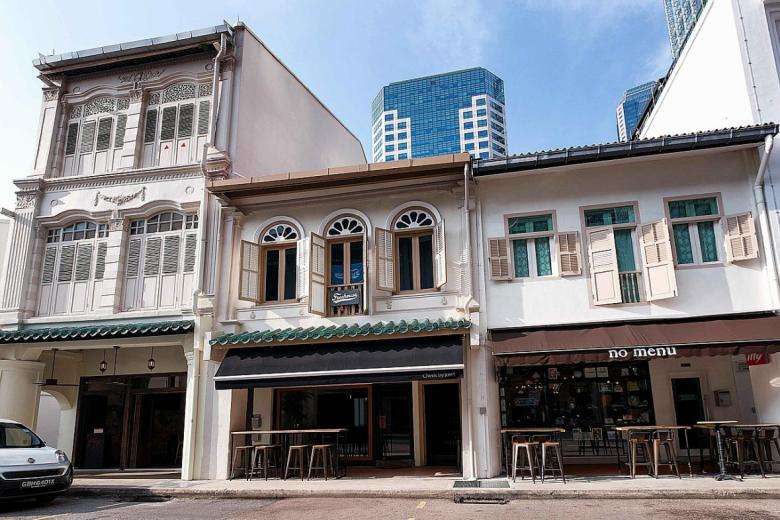
    HERITAGE VALUE: Capitol Building, built in 1933, has been gazetted for conservation, which means its facade must be kept when it is redeveloped. — PHOTO: BETTY CHUA FOR THE STRAITS TIMES

    Close to 90 per cent of tenants will be moving out by May next year. ‘We will inform the tenants of the need to move and work with them once the timing and details for the development of the site are finalised,’ said a spokesman for the Singapore Land Authority (SLA), which oversees the current tenants of these buildings.

    The buildings will be tendered out as a single integrated site, encompassing an area of about 1.45ha, an Urban Redevelopment Authority (URA) spokesman told The Straits Times.

    The timing and details of the tender are being studied but heritage buffs need not fear that a piece of Singapore history will be erased from the landscape.

    Three of these buildings have been gazetted for conservation, which means, among other things, that their facades must be maintained.

    Stamford House, built in 1904, is the oldest of the three buildings. Capitol Theatre was built in 1929, and Capitol Building, previously known as Shaw Building, in 1933.

    Asked why it was being redeveloped, the URA spokesman said that the area, between Hill Street and North Bridge Road along Stamford Road, has not ‘fully maximised its development potential’.

    The four buildings have a total of 250 tenants, including offices and retail outlets.

    The area has also drawn a cluster of boutiques run by home-grown designers such as Ms Celia Loe and Ms Baylene Li in recent years.

    Most are loath to move from their spacious premises set in a piquant environment, especially given the relatively low rents set by the SLA.

    Fashion designer Kevin Seah, 33, whose eponymous boutique has been in Stamford House for the past year, said: ‘It’s my dream place for a boutique since I decided to become a fashion designer at age 15. I love the classic architecture.’

    He is paying about $5 per sq ft for his store now, and expects to pay up to 10 times more if he relocates to a mall.

    Another boutique owner, Mr Nicholas Wong, 35, said the area attracts a good mix of locals and tourists, who are drawn by the cluster of local labels.

    ‘I think shopping here is quite a different experience from going to a typical mall. I hope Singapore’s shopping scene won’t be just all malls.’

    Property analysts reckon that the bigger developers would be keen to bid for the site. Likely bid prices are difficult to gauge as this would depend on the duration of the lease and conditions of development imposed by the authorities.

    Mr Nicholas Mak, director of research and consultancy at Knight Frank, liked the idea of having one developer to give the area a special feel, ‘instead of many different entities doing a more rojak kind of development with no coherent theme’.

    ‘But it also means that the whole development will either succeed or fail together. It’s putting all your eggs into one basket.’

    But it may well be easier for a single developer to make the long-vacant Capitol Theatre a lively place again, he added.

    Once owned by a Persian family and later Shaw Cinema, it was acquired by the URA in 1987. In 2000, the Singapore Tourism Board took over the building to explore alternative uses for it, but plans to turn it into a home for an arts group did not bear fruit.

    ‘Capitol Theatre wasn’t built as a cineplex, so it may need surrounding restaurants and retail outlets to draw crowds and generate revenue,’ said Mr Mak.

    Source : Straits Times - 3 Apr 2008

    Posted in Conservation, General, Office / Retail Space | No Comments »

    Preserve unique older condos like Clementi Park

    Posted by lushhomeonline on February 15, 2008

    MY CONDO Clementi Park was built in the 1980s. It is a rambling, spacious and spread-out estate with 494 units on a million sq ft of land. There isn’t a condo like it anywhere in Singapore. In the heart of my condo lies the unspoilt woods of Clementi Park. The hillside terrain, mature trees and park-like atmosphere would never be planned in the hustle-bustle world of today with its too-close buildings and utilitarian maximisation of land.

    Apart from the Clementi Park hill, the blocks of the condo were built to match the undulating character of the land. Blocks were built into the hillside so a fourth floor apartment could be four storeys high from the front, but on road level at the rear. Unique stepped structures with charm and quaintness are surrounded by utter greenery.

    Today, we marvel at conservation houses of 100 years ago for their historical value. Too many of them were demolished before we could fully appreciate what their loss would mean to us. I wonder if 50 years from now, our children’s children will find unique estates like Clementi Park of historical value architecturally? In any case, for its stunning internal nature parks, it is already worth preserving.

    In view of the urban renewal to Singapore’s old condos which is happening at an astonishing rate, perhaps we should stop the demolition of mature estates for now. Enough. Let’s look at the buildings of the past two, three or four decades with a different eye. They are a part of our history too.

    Susan Prior (Ms)

    Source: Straits Times - 15 Feb 2008

    Posted in Conservation, Enbloc, General | No Comments »

    Over 200 more buildings in Katong area may be conserved

    Posted by lushhomeonline on October 2, 2007

    THE rich heritage of Katong and Joo Chiat district will get more protection from the wrecking ball with a further 228 buildings earmarked for conservation status.

    The buildings include landmarks such as St Hilda’s Church, the Bethesda (Katong) Church and the former Grand Hotel in Still Road South.

    Three bungalows - in Marine Parade Road, Chapel Road and Joo Chiat Road - have also been selected.

    The buildings were selected to serve as markers of the area’s heritage.

    St Hilda’s Church, for example, was built in 1949 and is designed in a simple English parish church style while the former Grand Hotel building was built in 1917 in the ornamented Victorian style with a slight Indian influence.

    There are already about 700 buildings under conservation orders in the East Coast area, traditional home of Singapore’s Eurasian and Peranakan communities and a haven for food-lovers.

    The plan was announced by National Development Minister Mah Bow Tan yesterday at the Urban Redevelopment Authority’s (URA) Architectural Heritage Awards ceremony.

    The URA has told the building owners about the conservation plan. Its final decision will be made after feedback.

    Conservation orders mean owners cannot demolish the building or make major alterations to structures or facades.

    But the URA noted that most can be redeveloped to their full economic potential even if conserved.

    One owner, Ms Lyn Lee, 34, wants the certainty a conservation order would bring. Ms Lee, who owns the Awfully Chocolate cakeshop chain, lives in a pre-war, three-storey shophouse in Tembeling Road, one of a row of 10 houses.

    She and her husband bought the ageing freehold property for $880,000 six years ago and have spent about $500,000 renovating it into a home for themselves and their three children. They do not intend to move.

    ‘It’s very important that someday, somebody won’t come and mow down three houses and build a pink-tiled monstrosity,’ she said.

    Some of her neighbours are considering upgrading the neighbourhood if it is eventually conserved.

    The 228 buildings proposed for conservation were chosen from about 1,000 buildings in the area that are more than 30 years old. More than 6,500 buildings have been conserved in Singapore.

    The announcement was bittersweet for interest group Historic Architecture Rescue Plan, which has been lobbying the Government to conserve various properties in the district.

    One - a 95-year-old Amber Road bungalow - could only be partly conserved. Earlier this year, its developer agreed to build a hybrid apartment block incorporating some elements of the old building, but it plans to tear down its much vaunted crescent-shaped section.

    Mr Mah told the ceremony guests that Singapore had to strike a constant balance between redevelopment and conservation.

    Six projects were singled out in the URA awards yesterday for sensitive or innovative restoration work, including the National Museum and Chek Jawa Visitor Centre in Pulau Ubin.

    Mr Mah also announced the URA would be enhancing various districts next year. These include a 4.9km waterfront promenade from Punggol Point to Sungei Serangoon and a coastal promenade in Woodlands.

    It will also improve roadside infrastructure in Siglap and Upper Serangoon Road.

    Source : Straits Times - 2 Oct 2007

    Posted in Conservation, General | No Comments »

    Six restoration projects win Architectural Heritage Awards

    Posted by lushhomeonline on October 1, 2007

    Six restoration projects have won the Architectural Heritage Awards this year.

    They include the National Museum of Singapore’s $79m makeover as well as two private terrace houses that have been restored for modern-day living while retaining their historical charm.

    The National University of Singapore’s Law School on Bukit Timah Road is also one of the winners.

    The luxurious hotel suites at the Amara Sanctuary Resort Sentosa are the fifth winner of the award.

    Built on top of a small hill to enjoy the natural sea breeze surrounding Sentosa, the hotel suites were transformed from two former military barrack blocks housing British soldiers before and after World War II.

    But reminders of the past have been preserved in the transformation, including the former telegraphic posts and even a disused bomb shelter.

    Miyake Masaki, concept architect for Amara Sanctuary Partner, Miyake Masaki Associates, said: “The bomb shelter was a unique item and building in Singapore. So I intentionally kept this one… will convert it to a small party space or a wine cave. We have many possibilities there.”

    The sixth award winner is the House No. 1 located at the eastern tip of Pulau Ubin.

    It is believed to be Singapore’s only remaining authentic Tudor-style house with a fireplace. Its uniqueness fits in nicely with its new function as a visitor centre to Singapore’s nature treasure, Chek Jawa Wetlands.

    One of the two private houses that won the heritage award is situated at No.13, Martaban Road.

    Once used as a dormitory for orderlies from the nearby Tan Tock Seng Hospital, the two-storey terrace house has been charmingly turned into a chic, contemporary home without sacrificing its humble heritage.

    The other private house which won the award is the two-storey Early shophouse at No.62, Niven Road.

    The Architectural Heritage Awards were organised by the Urban Redevelopment Authority (URA).

    This year’s six winners bring the total number of projects that have received the Awards to 77 since the launch of the Awards in 1995.

    The award ceremony was held at the National Museum of Singapore.

    As Singapore develops, more is being done to preserve its past. Nearly 230 buildings in the Joo Chiat-Katong area are being considered for gazetting for conservation.

    This will add to some 700 buildings in the area that have already been gazetted for conservation.

    The majority are terrace and shophouses, including the two blocks at the junction of Everitt Road and Koon Seng Road. Also selected are St Hilda’s and Bethesda (Katong) Church, plus four bungalows.

    The URA is currently in consultation with the owners.

    National Development Minister Mah Bow Tan said that revitalising the areas is just as important as conserving the buildings.

    He said: “Holland Village is not the only village in Singapore, we’ve got a very lovely, quaint little place called Siglap Village. Again, I think, it is developing very nicely. So we will try to improve the roadside facilities at Siglap Village.”

    There are also plans to bring life back to Punggol Point, which used to be a chilli crab haven before the restaurants were closed down.

    Mr Mah said the waterfront at Punggol Point will be opened up with a new 4.9km promenade which stretches to Sungei Serangoon.

    Woodlands, too, will get a promenade.

    The projects will be ready by 2010. - CNA/ir

    Source : Channel NewsAsia - 01 Oct 2007

    Posted in Conservation, General | No Comments »

    Goodbye famous 5?

    Posted by lushhomeonline on August 7, 2007

    Architects lament five iconic buildings that are succumbing to en bloc fever and may soon go under the wrecking ball

    Thirty years or so ago, they were residential buildings that helped pioneer the start of modern architecture here. And they stood tall and proud during Singapore’s formative years.

    Mention their names, and they are bound to evoke a flood of memories for many Singaporeans: Pearl Bank Apartments in Outram Road, Golden Mile Complex in Beach Road, Futura in Leonie Hill Road, Beverly Mai in Tomlinson Road and The Habitat in Ardmore Park.

    Beverly Mai and Futura were Singapore’s first condominiums, Pearl Bank has its unusual horse-shoe shape, The Habitat is a distinctive child of the 1980s and rundown Golden Mile Complex was the first here to mix homes and businesses.

    Yet, the physical presence of these iconic five is set to be just a memory, too. The en bloc frenzy has them in its sights.

    While for owners this is a windfall, history buffs and architects told LifeStyle the razing of the iconic residences will be a loss for Singapore’s architectural heritage.

    The famous five are also written about in a book called Singapore 1:1 City, published two years ago by the Urban Redevelopment Authority and featuring a selection of significant architecture over the last 40 years.

    It may seem strange to think old condos are part of the Republic’s heritage, just like grand colonial buildings, monuments and conserved shophouses.

    Yet Mr Tai Lee Siang, president of the Singapore Institute of Architects (SIA), says these residential projects have left a strong impression on the collective memory of Singapore.

    ‘They also have a unique architecture form and were designed by local architects,’ he says. Beverly Mai was designed by Singapore architect Timothy Seow in 1974 and was the first to introduce the condo principle of high-rise living and shared facilities to Singaporeans.

    Dr Goh Chong Chia, managing director of TSP Architects & Planners, who worked with Mr Seow on the project, says Beverly Mai marked a change in housing type. ‘It was a pioneer of luxury housing,’ notes Dr Goh, an SIA past president.

    Futura, also designed by Mr Seow in 1976, certainly lived up to its name. Mr Tai points out that its unique form lies in the space-pod look of the living spaces.

    ‘Clearly inspired by the space age explorations, the design is bold and futuristic in outlook,’ he says.

    He adds that although its location at Leonie Hill created less impact in the public memory due to its status as a high-end private development off Orchard Road, ‘there is no denying that the building is a quiet tour de force in Singapore architecture landscape’.

    Architect Mink Tan of Mink Tan Architects agrees that these five buildings should be kept because of their historical significance to local architecture.

    He is passionate about retaining Golden Mile Complex, which, of the five, is the only one whose en bloc sale is uncertain.

    ‘The complex marks our first mixed-use development,’ he says, and he hopes that instead of tearing it down, it can be refurbished to its original condition.

    Dr Kevin Tan, president of the Singapore Heritage Society, says the five are ‘all important and aesthetically and architecturally important buildings. Their demise or impending demise is to be much lamented’.

    The SIA, meanwhile, is working to identify modern buildings that are less than 30 years old that may be worthy of recognition and future conservation - even though it is too late for the five featured here.

    ‘To realise the development of potential of these buildings that may be demolished due to en bloc sale, SIA would like to make suggestions to the relevant authority on how to integrate the new potential with the old landmarks,’ says Mr Tai.

    However, home-owners at these landmark buildings have a different take. Ms Wong Chin Chin, a Pearl Bank Apartments resident for 11 years, says most owners in her block have agreed to sell at prices of about $1,300 psf, but adds it is more than just the money. Factors pushing them to sell include high maintenance fees, leaky pipes and lifts that break down.

    ‘No doubt the building is unique and historical, but living and dealing with the inconvenience is a chore,’ she says.

    Welcome to my horse shoe
    PEARL BANK APARTMENTS 1 Pearl’s Hill

    The deal: LifeStyle understands from residents and industry experts that more than the mandatory 80 per cent of residents have agreed to sell. The apartments, near Outram Park MRT, could fetch more than $500 million.

    History: The building was designed by local architect Tan Cheng Siong of Archurban Architects Planners, and completed in 1976.

    Why it’s so special: The 280-unit, 38-storey Pearl Bank Apartments has a distinctive horse-shoe shape for a reason. The block’s horse-shoe opening faces west, shading the building from the afternoon sun.

    Being located on a hill, it was the tallest residential building in Singapore at the time. And it had the highest density of apartments for a private residential development.

    There are eight penthouses and 272 split-level units that are either two-, three- or four-bedroom apartments, with eight units to a floor.

    Much thought went into the layout. Living rooms and bedrooms are at the front, giving great city views. Utilities and service areas are situated at the rear, overlooking a courtyard.

    ‘Slum’ becomes landmark
    GOLDEN MILE COMPLEX 5001 Beach Road

    The deal: The en bloc is not yet a done deal. Some owners at the strata-titled mixed development are lobbying for one. But there are many units and it may be difficult to get the mandatory minimum of 80 per cent of individual owners to agree.

    History: The 16-storey building, with 411 shops, 226 offices and 68 residential units, was designed by Gan Eng Oon, William Lim and Tay Kheng Soon of then Design Partnership - now known as DP Architects - and was completed in 1973.

    Why it’s so special: It pioneered the idea of a mixed-use development. And its unique sloping form is unforgettable.

    Today the complex is a hot spot for Thai clubs and eateries, as well as travellers going to Malaysia by bus.

    It was even mentioned in Parliament once, when it was described as a national disgrace and a vertical slum because residents had put up zinc sheets and patched boards over their balconies to create an extra room.

    The complex may look run down, but it is appreciated by architecture gurus.

    Dutch architect Rem Koolhaas said at a press conference when he visited Singapore in 2005: ‘These buildings (Golden Mile Complex and People’s Park Complex) were not intended to be landmarks, but became landmarks.’

    Pritzker Prize-winning Japanese architect Fumihiko Maki said it is a prime example of an urban building where people can live, work, shop and play - all in a single development.

    Professor William Lim, a veteran architect here, says the demolition of the complex ‘will be a definite loss for Singapore’.

    Living in a space-pod
    FUTURA 14 Leonie Hill Road

    The deal: The condo, with 69 units and three penthouses, was sold en bloc last year for $287.3 million to City Sunshine Holdings, a subsidiary of City Developments. However, the deal is still in the works as minority owners have gone to court, claiming that the sale was not made in good faith.

    History: It was completed in 1976.

    Why it’s so special: Futura was the second condominium to be built in Singapore. Its main architect is Mr Timothy Seow, who also designed Singapore’s first condo, Beverly Mai, two years earlier. This, too, has gone en bloc.

    The Futura was the first residential project to incorporate lifts that open directly into the apartments, giving residents much privacy. It was a novelty to most Singaporeans living in flats with a shared lift opening onto a shared corridor.

    The 25-storey block has a distinctive curved facade, a move away from the usual linear configurations.

    Its name reflects its architecture, considered advanced at the time: three radial wings linked by a central service core. As a result, the living rooms are in an elliptical shape, resembling space-pods, while the rooms are geometric shaped.

    Airy bungalow
    BEVERLY MAI 31 Tomlinson Road

    The deal: The 28-storey tower was sold en bloc in April last year for $238 million to Hotel Properties Ltd (HPL).

    History: It was built in 1974.

    Why it’s so special: It helped kick off Singaporeans’ famous obsession with attaining the 5Cs: car, credit card, cash, country club and, of course, condos.

    Yes, this is Singapore’s first condo.

    It was built by architect Timothy Seow, who also designed several other old favourites in LifeStyle’s feature.

    Mr Seow, founder of Timothy Seow & Partners, now known as CPG Consultants, pioneered the ‘bungalow-in-the-air’ concept with Beverly Mai. The 48 maisonettes, two deluxe apartments and two-storey luxury penthouses are all linked by a central service core, giving residents privacy.

    As the first condo, it had other firsts - the first to incorporate shared facilities such as a swimming pool, to have maisonettes and to have apartment units with no party walls.

    It also has big balconies, inspiring residents to build gardens in the sky.

    Prefab boxes
    THE HABITAT 1 & 2 2 & 3 Ardmore Park

    The deal: Property developer Wheelock Properties bought Habitat 1 for $180 million last year, and Habitat 2 for $103.88 million in 2005. The site of Habitat 2 and its neighbouring Ardmore View, which was also sold en bloc, is making way for Ardmore II condo. Habitat 1, which is still standing, will become Ardmore III condo.

    History: The condo was completed in 1984, and was designed by local firm

    RDC Architects in association with internationally renowned American firm Moshe Safdie & Associates.

    Why it’s so special: The two blocks can be considered a local version of Montreal’s Habitat ‘67, a housing project done by Moshe Safdie for the 1967 World Exposition. The Canadian project, today a heritage landmark, pioneered the design and implementation of three-dimensional prefabricated housing. Each unit, resembling a box, was constructed elsewhere and connected together on site. There are 158 units.

    Singapore’s version is similar but on a smaller scale - there are just 61 units in both blocks.

    It makes use of the same concept as in Montreal - vertically stacked precast boxes with hanging roof terraces, giving the condo a three-dimensional facade.

    Both towers have single-storey units and maisonettes that overlook a garden with a pool and squash courts.

    Source : Sunday Times - 5 Aug 2007

    Posted in Conservation, Enbloc, General | No Comments »

    Call to preserve 1912 ‘crescent’ house

    Posted by lushhomeonline on July 23, 2007

    A GROUP of heritage property lovers are trying to save a bungalow designed by the architect of Raffles Hotel that could be facing demolition after it was bought recently by a developer.

    The neo-Renaissance style bungalow on Amber Road was designed by Regent Alfred John Bidwell in 1912.

    The two-storey property, which stood on the seafront before land reclamation began, has an unusual crescent shape to let in as much fresh air as possible. It is currently surrounded by many private housing projects.

    A new developer, AG Capital, bought the bungalow last year. The company told The Straits Times ‘no corporate decision has been adopted’ on future plans for the site.

    The company is free to tear it down though, as the Urban Redevelopment Authority (URA) has no plans to add it to its list of more than 6,000 buildings that have to be retained because of their historical heritage value.

    The URA told The Straits Times it adopted a ‘pragmatic’ approach to conservation. It said: ‘It is done on a highly selective basis to retain the unique character and identity of an area.

    ‘We have adopted a ‘win-win’ approach to strike a balance in allowing owners to realise the economic potential of their properties and ensuring the identity and character of our historic past are retained.’

    However, a group of about 20 people, who call themselves the Historic Architecture Rescue Plan, feel this bungalow deserves preservation. On Christmas Eve, the group distributed fliers about the bungalow to residents in the Mountbatten area.

    One member, Mr Terrence Hong, 26, unemployed, suggested the building be dismantled and relocated rather than demolished.

    Destroying buildings like this would ‘contribute to the sense of impermanence and unrootedness in Singapore’, he said.

    Another member, 72-year-old retired administrator Helen Khoo, said: ‘Modern buildings are okay in themselves. But when we have too many, we start everything on a clean slate and rub off all the happy memories.’

    The group is trying to get the authorities to conserve at least 12 other buildings.

    They include private buildings like the National Aerated Water Company building in Serangoon Road, the Shaw Brothers film studio in Jalan Ampas, off Balestier Road, as well as state properties like a two-storey manor in Gilstead Road that used to be home to Leslie Charteris, author of the mystery books that inspired the television series, The Saint.

    The conservation group tries to raise awareness of heritage properties by giving their owners or tenants information on their historical value. They recently approached Gracefields Kindergarten, which rents the house in Gilstead Road.

    The imposing 1920s building, which used to house the Spastic Children’s Association, was painted a cheery mint green when the kindergarten took up the tenancy in August.

    Its principal, Ms Joyce Teo, 50, said that since then, at least eight people have walked in to express admiration for the building.

    ‘I stand in awe. Every day that I stand here, I am grateful for this place,’ she said. ‘It’s so majestic.’

    Source : Straits Times - 7 Jan 2007

    Posted in Conservation | No Comments »